Why Terrance Wilson Calls This a Once-in-a-Century Moment for Seattle Real Estate
We closed out our recent conversation with Terrance Wilson — the land use attorney behind our last two posts on condo versus unit lot subdivision and bank reconveyance — by asking him a bigger question. Not “how do I permit this,” but “why does any of this matter?”
His answer is worth sharing on its own.
A once-in-a-century moment
“There’s maybe only been two or three other times this significant, since Washington became a state in the late 1800s.”
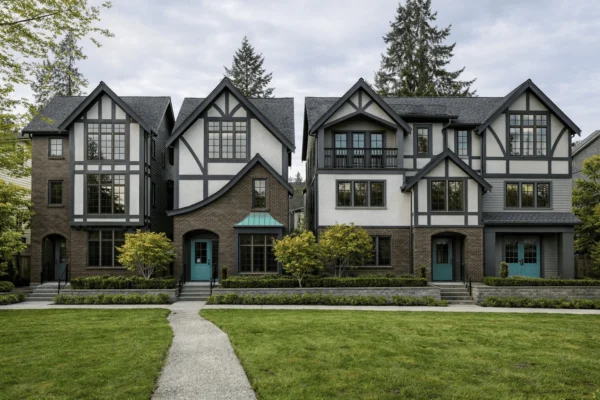
His list: the gold rush of the late 1800s, which put Washington on the map. The post-World War II GI Bill and the building of I-405, which put the suburbs on the map. And now, statewide middle housing law, letting 70 to 80 Washington cities allow four or more homes on a single-family lot.
“This is a time like nobody’s business,” he said.
The economics behind it
Terrance doesn’t see this as a bubble. He sees it as a response to real demand.
Washington’s Puget Sound region is expected to add one to two million more people over the next 10 to 20 years. Middle housing — by definition smaller, denser, and closer to jobs than the traditional single-family home — is one of the only price points that gets someone into a neighborhood that used to be out of reach.
Where he sees real risk is on the construction cost side, not the demand side, and that risk isn’t evenly spread. A home that costs $500,000 to build only pencils if it sells for meaningfully more than $500,000 — which depends entirely on the neighborhood.
Why four homes can pencil when one doesn’t
We asked him about something we’ve noticed firsthand: a single DADU often doesn’t pencil. Two barely does. But knock a house down and build four, and suddenly the math works.
Terrance’s explanation is simple. You’re spreading the cost of the foundation, the siding, the roofing across more homes. A DADU is also the most expensive housing product per square foot that exists — a full kitchen, bathroom, and utilities crammed into roughly a thousand square feet — while a larger home spreads those same fixed costs over more livable space.
“It’s not a gold rush for every product you can think of,” he said. Getting the highest and best use out of a site takes real thought, and it isn’t always the maximum number of units. Sometimes a three-unit project pencils better than six.
A candid note on where prices are headed
Terrance didn’t dodge the uncomfortable part of this story either. Seven years ago, a DADU that cost $300 a square foot to build sold for $550,000 to $600,000. Today, that same product costs $500 to $550 a square foot to build — and sells for $700,000 to $800,000. In Kirkland, it’s closer to $1.1 to $1.2 million.
“That’s never really going to go away,” he said. As more builders, developers, and investors move into the space, prices tend to keep climbing to match whatever the market can absorb.
Building wealth, not just building homes
The part of this Terrance seems most energized by isn’t the volume builders — it’s the homeowners.
He described people wanting to age in place without leaving their neighborhood, grocery store, or church. Boomerang kids moving back from college who can’t yet afford their own place. Homeowners building two or three units and living off the rental income as a bridge into retirement.
One strategy he mentioned specifically: move into a newly built unit, live there two years, sell it, and use the capital gains exclusion under IRC Section 121 — up to $250,000 for an individual or $500,000 for a married couple — then move into the next unit and repeat. Done across three or four units, that can mean $750,000 to $1,000,000 in gains with no federal tax owed on any of it.
There’s also a federal tax angle for people renting these units out. Cost segregation studies can reclassify parts of a property into shorter depreciation schedules, and under 2025’s federal tax legislation, 100% bonus depreciation was made permanent for qualifying property placed in service on or after January 20, 2025 — meaning that depreciation can be taken in year one instead of spread over decades.
Skin in the game
Terrance isn’t just advising from the sidelines. He owns six properties personally, including a DADU in West Seattle he bought for his daughter, who’s moving up for grad school at the University of Washington. He was paying $4,000 a month for her apartment in Los Angeles. Now he’s paying the same $4,000 a month — except he owns the asset.
“I’m feeling it viscerally in my bones,” he said.
The bottom line
Terrance has been doing land use and survey work in Washington since 1996 — through the last real estate cycle, the 2008 recession, and now this one. His read: nobody knows exactly how many years this window stays open. But the building blocks — parent parcels, condos, unit lot subdivisions, all the things we’ve covered in this series — aren’t new concepts. They’re just newly available on land that couldn’t use them before.
“There’s a ship at the port, ready to take you off to the land of some opportunity. The question is, do you want to get on and go check it out, or are you going to sit on the sidelines and watch it happen?”
A quick reference
- 26 U.S.C. § 121 — federal capital gains exclusion on the sale of a principal residence ($250,000 single / $500,000 married, unchanged since 1997)
- 100% bonus depreciation — made permanent by 2025 federal tax legislation for qualifying property placed in service on or after January 20, 2025
Thinking about what your own property could support? We’d love to help you think it through — contact us to start the conversation. Thanks to Terrance Wilson for these conversations, and for putting his own money where his mouth is.
Related: Condo vs. Unit Lot Subdivision (FAQ) | Bank Reconveyance, Refinancing, and Middle Housing